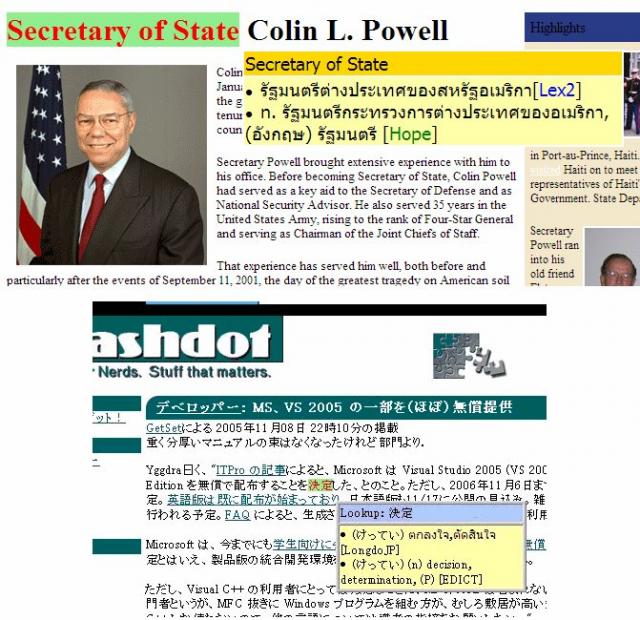
Longdo.COM:      Dict (พจนานุกรม)     Map (แผนที่ประเทศไทย)     Traffic (จราจร)     Mobile (มือถือ)     Law (กฎหมาย)     PopThai (ติดคำแปล)    
ลองดู: บริการค้นหาคำและร่วมสร้างเนื้อหาพจนานุกรมไทย
Multiple Bilingual Dictionary Search and Compilation Service
English - Thai, Japanese - Thai, German - Thai, French - Thai Dictionary
View pages in Thai / View pages in English
 
 
ใส่คำที่ต้องการค้นหาหรือ URL สำหรับบริการ PopThai
[ตัวอย่างเช่น cat, cnn.com, slashdot.jp] ดูคำแนะนำ suggest
ขยายขนาดเพื่อใส่ข้อความหลายบรรทัด
เลือกบริการ:
 
เนื้อหา

 
Search result for been (37 entries) (0.0031 seconds)
ลองค้นหาคำในรูปแบบอื่นๆ เพื่อให้ได้ผลลัพธ์มากขึ้นหรือน้อยลง: -been-, *been*. Possible hiragana form: べえん
English-Thai: NECTEC's Lexitron-2 Dictionary [with local updates]
been[VI] เป็น, See also: อยู่, คือ, Syn. be
been had[SL] โดนโกง, Syn. was had

English-Thai: HOPE Dictionary [with local updates]
been(บีน) pp. ของ be -Conf. gone
has-beenn. บุคคลหรือสิ่งของที่มีชื่อเสียงในอดีต,บุคคลที่เคยประสบความสำเร็จ สิ่งที่เคยประสบความสำเร็จ

English-Thai: Nontri Dictionary
been(vt) pp ของ be

Thai-English-French: Volubilis Dictionary 1.0
ได้ข่าว[v. exp.] (dāi khāo) EN: hear ; get the news of ; get wind of sth ; it has been reported that   
ได้รับมอบอำนาจ[v. exp.] (dāirap møp-amnāt) EN: be authorized ; have been authorized   
ได้เสีย[v.] (dāisīa) EN: have sexual relations without marriage ; become intimate sexually ; have sexual intercourse ; have been intimate   FR: se mettre en concubinage
ของหลุด[n. exp.] (khøng lut) EN: pawned article that has not been redeemed   
มีประกาศว่า...[v. exp.] (mī prakāt wa ...) EN: it has been announced that ...   
ไปไหนมา[v. exp.] (pai nai mā) EN: Where have you been ?   FR: d'où venez-vous ? ; d'où viens-tu ?
ตกกระป๋อง[v. exp.] (tok krapǿng) EN: be out of favour ; have a downfall ; become a has-been ; suffer a misfortune   FR: être en disgrâce

CMU English Pronouncing Dictionary
BEEN B IH1 N
BEEN B AH0 N
BEENE B IY1 N
BEENS B IH1 N Z
BEENEY B IY1 N IY0
BEENKEN B IY1 NG K AH0 N

Oxford Advanced Learners Dictionary (pronunciation guide only)
been (v) (b ii n)

German-English: TU-Chemnitz DING Dictionary
Beendigung {f}; Beendung {f}; Abschluss {m}; Erledigung {f} | nach Abschluss des Kursescompletion | on completion of the course [Add to Longdo]
Beendigung {f}determining [Add to Longdo]
Beendigung {f}ending [Add to Longdo]
Beendigung {f}finalization [Add to Longdo]
Beendigung {f}; Terminierung {f}; Kündigung {f}termination [Add to Longdo]
ausgekanntbeen well versed [Add to Longdo]
beenden; erledigen; fertigstellen; zu Ende führen; vollenden | beendend; erledigend; fertigstellend; zu Ende führend; vollendend | beendet; erledigt; fertiggestellt; zu Ende geführt; vollendet | beendet | beendet; vollendetto finish (off) | finishing | finished | finishes | finishes [Add to Longdo]
beenden | beendetto determine | determines [Add to Longdo]
beenden | beendend | beendet | beendetto finalize; to finalise [Br.] | finalizing | finalized; finalised [Br.] | finalizes; finalises [Add to Longdo]
beendento finite [Add to Longdo]

Japanese-German: JDDICT Dictionary
[りょう, ryou] BEENDEN, VERSTEHEN [Add to Longdo]
済ます[すます, sumasu] beenden, bezahlen, sich_behelfen (mit) [Add to Longdo]
終える[おえる, oeru] beenden [Add to Longdo]
[ひ, hi] BEENDEN, ZURUECKZIEHEN [Add to Longdo]

Result from Foreign Dictionaries (4 entries found)


From The Collaborative International Dictionary of English v.0.48 [gcide]:

  Be \Be\ (b[=e]), v. i. [imp. {Was} (w[o^]z); p. p. {Been}
     (b[i^]n); p. pr. & vb. n. {Being}.] [OE. been, beon, AS.
     be['o]n to be, be['o]m I am; akin to OHG. bim, pim, G. bin, I
     am, Gael. & Ir. bu was, W. bod to be, Lith. bu-ti, O. Slav.
     by-ti, to be, L. fu-i I have been, fu-turus about to be,
     fo-re to be about to be, and perh. to fieri to become, Gr.
     fy^nai to be born, to be, Skr. bh[=u] to be. This verb is
     defective, and the parts lacking are supplied by verbs from
     other roots, is, was, which have no radical connection with
     be. The various forms, am, are, is, was, were, etc., are
     considered grammatically as parts of the verb "to be", which,
     with its conjugational forms, is often called the substantive
     verb. [root]97. Cf. {Future}, {Physic}.]
     1. To exist actually, or in the world of fact; to have
        existence.
        [1913 Webster]
  
              To be contents his natural desire.    --Pope.
        [1913 Webster]
  
              To be, or not to be: that is the question. --Shak.
        [1913 Webster]
  
     2. To exist in a certain manner or relation, -- whether as a
        reality or as a product of thought; to exist as the
        subject of a certain predicate, that is, as having a
        certain attribute, or as belonging to a certain sort, or
        as identical with what is specified, -- a word or words
        for the predicate being annexed; as, to be happy; to be
        here; to be large, or strong; to be an animal; to be a
        hero; to be a nonentity; three and two are five;
        annihilation is the cessation of existence; that is the
        man.
        [1913 Webster]
  
     3. To take place; to happen; as, the meeting was on Thursday.
        [1913 Webster]
  
     4. To signify; to represent or symbolize; to answer to.
        [1913 Webster]
  
              The field is the world.               --Matt. xiii.
                                                    38.
        [1913 Webster]
  
              The seven candlesticks which thou sawest are the
              seven churches.                       --Rev. i. 20.
        [1913 Webster]
  
     Note: The verb to be (including the forms is, was, etc.) is
           used in forming the passive voice of other verbs; as,
           John has been struck by James. It is also used with the
           past participle of many intransitive verbs to express a
           state of the subject. But have is now more commonly
           used as the auxiliary, though expressing a different
           sense; as, "Ye have come too late -- but ye are come. "
           "The minstrel boy to the war is gone." The present and
           imperfect tenses form, with the infinitive, a
           particular future tense, which expresses necessity,
           duty, or purpose; as, government is to be supported; we
           are to pay our just debts; the deed is to be signed
           to-morrow.
           [1913 Webster]
  
     Note: Have or had been, followed by to, implies movement. "I
           have been to Paris." --Sydney Smith. "Have you been to
           Franchard ?" --R. L. Stevenson.
           [1913 Webster]
  
     Note: Been, or ben, was anciently the plural of the
           indicative present. "Ye ben light of the world."
           --Wyclif, Matt. v. 14. Afterwards be was used, as in
           our Bible: "They that be with us are more than they
           that be with them." --2 Kings vi. 16. Ben was also the
           old infinitive: "To ben of such power." --R. of
           Gloucester. Be is used as a form of the present
           subjunctive: "But if it be a question of words and
           names." --Acts xviii. 15. But the indicative forms, is
           and are, with if, are more commonly used.
           [1913 Webster]
  
     {Be it so}, a phrase of supposition, equivalent to suppose it
        to be so; or of permission, signifying let it be so.
        --Shak.
  
     {If so be}, in case.
  
     {To be from}, to have come from; as, from what place are you?
        I am from Chicago.
  
     {To let be}, to omit, or leave untouched; to let alone. "Let
        be, therefore, my vengeance to dissuade." --Spenser.
        [1913 Webster]
  
     Syn: {To be}, {Exist}.
  
     Usage: The verb to be, except in a few rare cases, like that
            of Shakespeare's "To be, or not to be", is used simply
            as a copula, to connect a subject with its predicate;
            as, man is mortal; the soul is immortal. The verb to
            exist is never properly used as a mere copula, but
            points to things that stand forth, or have a
            substantive being; as, when the soul is freed from all
            corporeal alliance, then it truly exists. It is not,
            therefore, properly synonymous with to be when used as
            a copula, though occasionally made so by some writers
            for the sake of variety; as in the phrase "there
            exists [is] no reason for laying new taxes." We may,
            indeed, say, "a friendship has long existed between
            them," instead of saying, "there has long been a
            friendship between them;" but in this case, exist is
            not a mere copula. It is used in its appropriate sense
            to mark the friendship as having been long in
            existence.
            [1913 Webster]

From The Collaborative International Dictionary of English v.0.48 [gcide]:

  Been \Been\ [OE. beon, ben, bin, p. p. of been, beon, to be. See
     {Be}.]
     The past participle of {Be}. In old authors it is also the
     pr. tense plural of {Be}. See 1st {Bee}.
     [1913 Webster]
  
           Assembled been a senate grave and stout. --Fairfax.
     [1913 Webster]

From English-German Freedict dictionary [fd-eng-deu]:

  been [biːn]
     gewesen; sein
  

From English-German Freedict dictionary [fd-eng-deu]:

  been} [biːn]
     sein
  

Are you satisfied with the result?

You can...

  • Suggest your own translation to Longdo
  • Search other online dictionaries

  • Time: 0.0031 seconds, cache age: 2.723 (clear) ^

    Copyright (c) 2003-2009 Metamedia Technology, Longdo Dict is a service of Longdo.COM
    Disclaimer: Longdo provides neither warranty nor responsibility for any damages occured by the use of Longdo services. Longdo makes use of many freely available dictionaries (we are really grateful for this), please refer to their terms and licenses (see Longdo About page).